
Round them up. Hoard them. Then squish them all at once.
Ninety-six little monsters live at the bottom of the water. They watch your finger. Bigger groups pay far, far more — so this is not a game about spotting a match, it is a game about how big you can grow something before it falls apart.
Play free in your browser Get it free on Google Play Get it free on the App Store Free, nothing to install, and nothing to sign up for. The browser version needs a keyboard-and-mouse computer. There is a free browser version too, but it wants a bigger screen than this one — open this page on a computer.
Ninety-six of them
They can see you, you know
Ninety-six little monsters live at the bottom of the water. They watch your finger. They blink when they feel like it. When you close in on their group, their eyes go wide and their mouths fall open.
Squish them anyway.
Tap a group of touching monsters of the same color. They pulse, a ring draws around them, and the score you would get floats above their heads. Tap again and they pop. Whatever is left falls into the hole, empty columns slide shut, and the board is a different board than it was a second ago.
Gus
The biggest one is not exactly on your side
Gus hangs over the board and talks you through your run in a voice that
keeps sliding out of encouragement into something else.
They can see you, you know.
Squish a monster that was all on its own and he goes cold and gray:
You took a lonely one. Rude.
Pull off something enormous and he
comes down off his perch to stomp the group flat himself.
The one rule that matters
Bigger is better. Much better.
Every monster you add to a group is worth more than the one before it. Ten together are worth 356 points. Split those same ten into two fives and you get 152. So this is not really a game about spotting a match. It is a game about how big you can grow something before it falls apart.
You can squish a monster that is all on its own. It costs you 100 points. That one rule is what makes this a thinking game: tidying up has a price, and the last few moves of a round turn into a real decision. Clear the whole board without ever taking a lonely one and your score doubles.
You always see what a group is worth before you take it. Nothing is hidden from you.
In motion
Six moments from a run
-
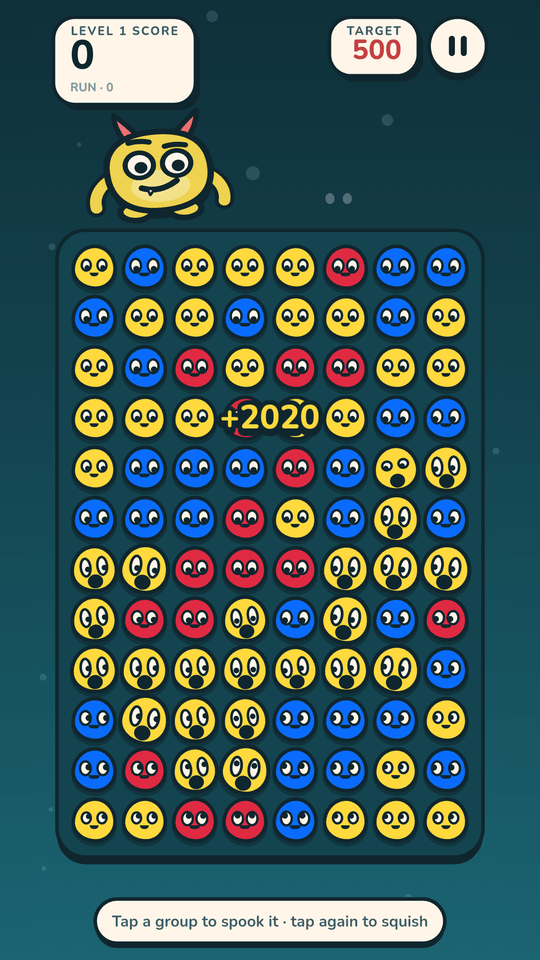
The score is on the table before you commit -
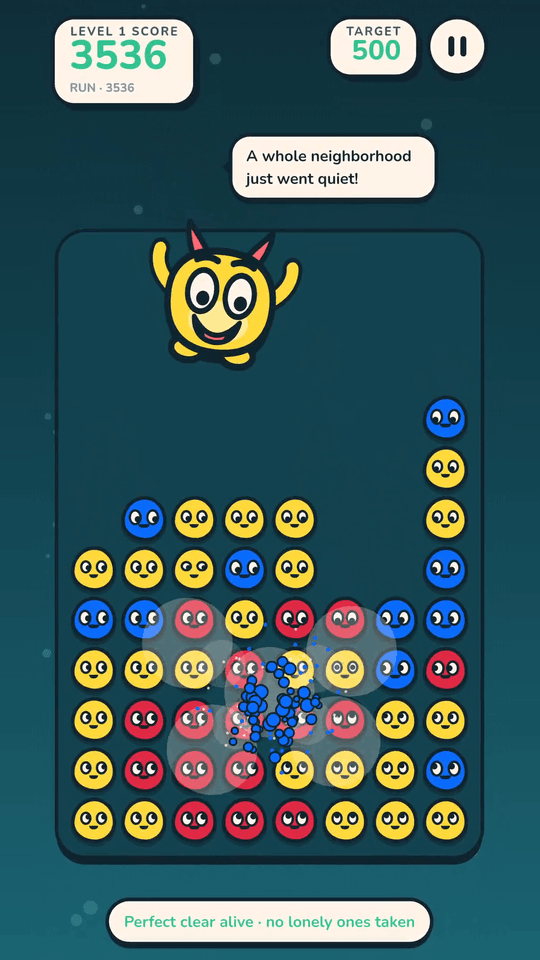
Gus comes down for the big ones -
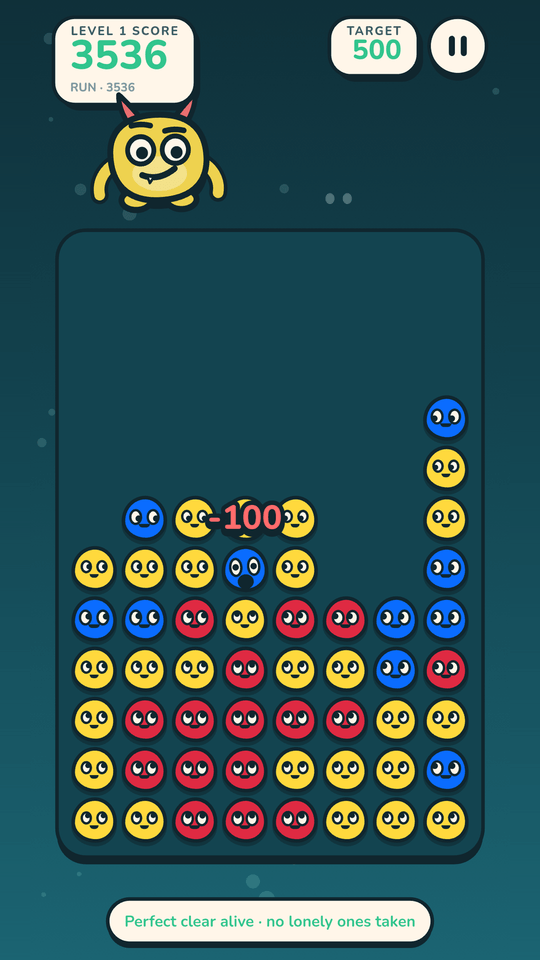
A lonely one is legal. It just costs you. -
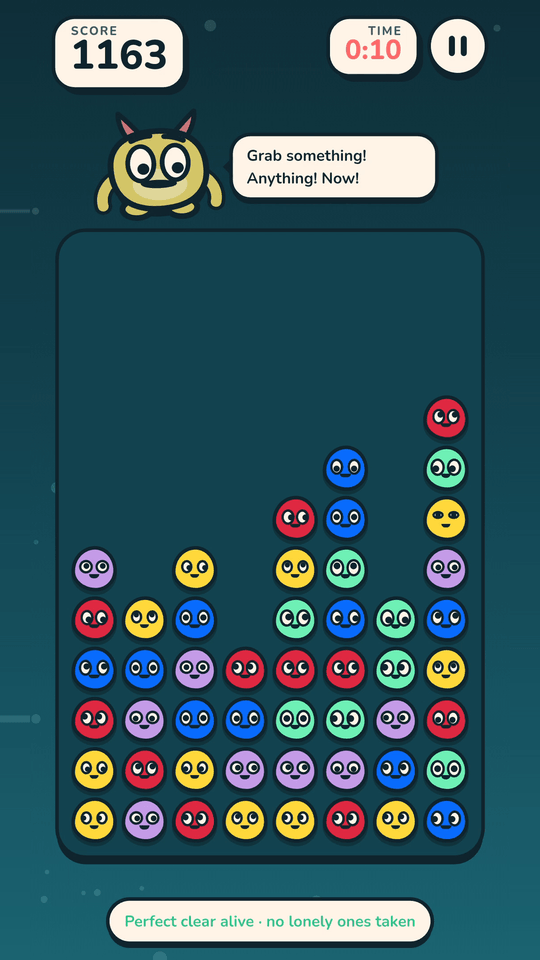
120 seconds. Move fast, score more. -
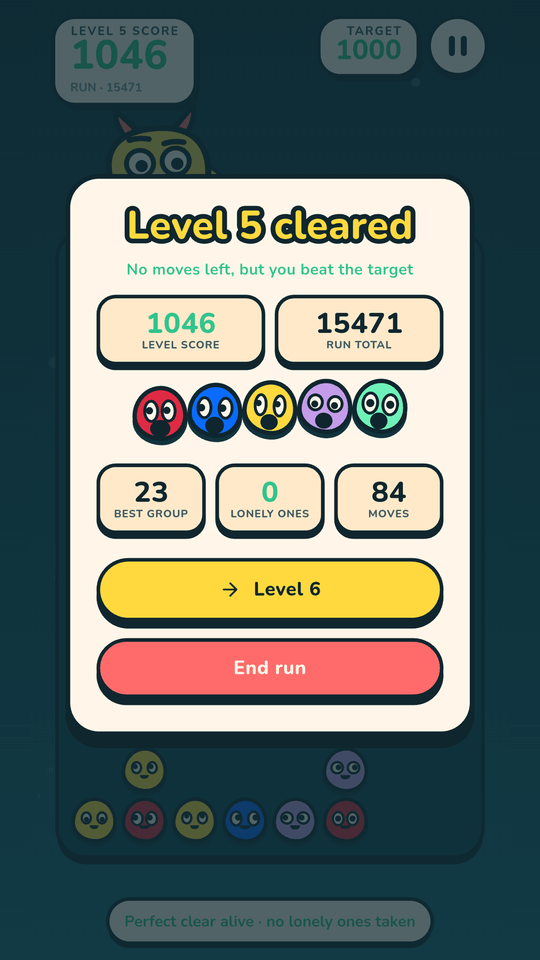
The ladder has no top -
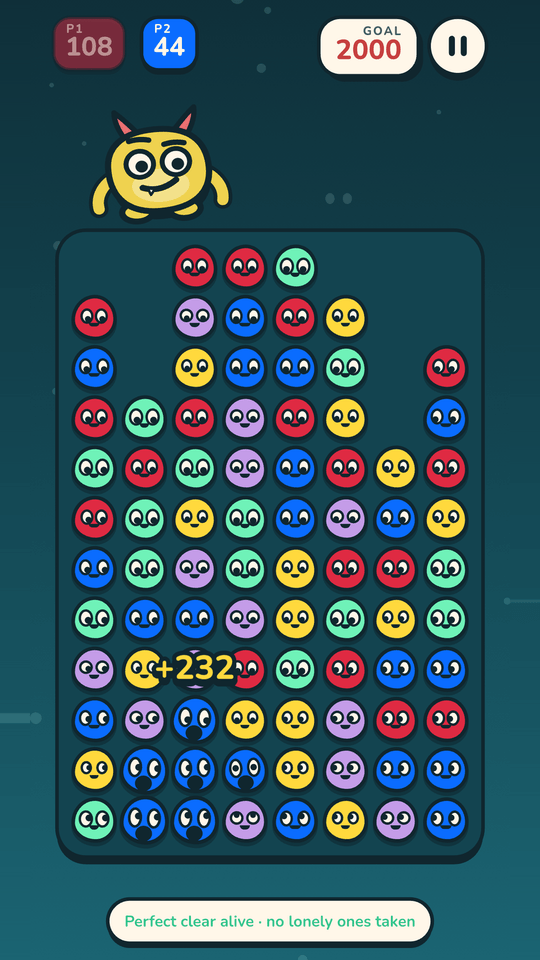
Two players, one board, one phone
Scroll sideways for the rest.
Four ways to play
Same board, four arguments with it
-
Level
Hit the target score and go deeper. There is no last level, and you never lose your place. Put the game down for a week and you come back to the deepest level you ever reached.
-
Timed
120 seconds. The faster you move, the more each squish is worth, and every second you have left over pays out at the end.
-
Endless
No clock, no target. Just you and the board.
-
Versus
Two players, one phone. Take turns. Your own color is worth double to you. First to 2000 wins.
Six colors, six temperaments
Each one panics differently
Each has its own eyes, its own way of blinking, and its own way of panicking when you come for it. The six were chosen to stay easy to tell apart, including if you are color blind.
- Blush
- Sky
- Yolk
- Wisp
- Mint
- Berry
What is not in it
Nothing left down there but water
-
No ads
Not a banner, not an interstitial, not a rewarded video. Nothing interrupts a game.
-
No in‑app purchases
There is no shop. Nothing is locked behind a currency, and nothing is easier to win if you pay.
-
No account
No sign-in, no profile, nothing to connect. Open the game and it is already yours.
-
No ad tracking
No ads, so no advertising ID and no ad network watching you. Nothing about you is sold to anyone.
-
Plays offline
Your scores and progress live on your device. Put the phone in airplane mode and nothing changes.
Ten pieces of music, written for this game. None of them loop, so none of them wear out. The rules are borrowed from a 1999 arcade puzzle classic, and they have not been watered down since.
Squish does send crash reports, so we can fix what breaks, and a report you write yourself if you use the in-game feedback button — that one includes what the game was doing when you wrote it. Both are covered in the privacy policy.